
Fleet Dashcam Guide for Small Fleets: Cut the Fluff and Save Money
Meta Description: Fleet dashcam for small fleet buyers: compare costs, contracts, insurance benefits, and the best options for 5–20 truck operations.
97% of US trucking companies operate fewer than 20 trucks, according to data from the American Trucking Associations. Yet most fleet camera vendors build products, pricing models, and contracts around carriers running hundreds of vehicles. If you've been quoted enterprise pricing, pushed into a three-year agreement, or told you need dozens of features you'll never use, this guide is for you. A fleet dashcam for small fleet operations should reduce risk, protect drivers, and pay for itself without adding another management headache.

Small fleets have different needs, budgets, and priorities than enterprise carriers.
The 3 Biggest Mistakes Small Fleet Owners Make When Buying a Dashcam
Paying for enterprise features you will never use
Many small carriers buy software designed for 500-truck operations. They end up paying for advanced workflow automation, custom reporting, fuel analytics, and integrations they never touch.
For a dashcam for small trucking company operations, the goal is simple: capture evidence, improve safety, and resolve claims faster. If you spend ten minutes a week inside the platform, you probably don't need enterprise-level analytics. Focus on video quality, event recording, and ease of use rather than feature lists built for dedicated safety departments.
Signing a multi-year contract with no exit
Some vendors use low monthly pricing to make long-term agreements look attractive. The problem appears later when service quality drops or your business changes.
A three-year contract can lock a small fleet into thousands of dollars of future payments. Before signing, ask about cancellation fees, hardware ownership, and early termination clauses. A good vendor should clearly explain your exit options before asking for a signature.
Treating hardware cost and monthly fee as separate decisions
This is one of the most expensive mistakes small fleet owners make. A vendor may advertise inexpensive hardware while recovering costs through higher monthly subscriptions.
Always calculate the full ownership cost over at least three years. A camera that costs $100 more upfront may save thousands over the life of the contract. [INTERNAL LINK: fleet dashcam pricing guide]
What a Small Fleet Actually Needs From a Dashcam

The five features most small fleets actually need from a dashcam system.
Small fleets do not need dozens of features. They need a few things that work reliably.
HD road-facing footage
Video quality determines whether footage helps during a claim. Look for at least 1080p recording with strong night performance and a wide field of view.
Driver monitoring
Driver-facing cameras remain controversial, but they can protect drivers against false accusations. Many fleets choose privacy-focused settings that only record during safety events.
GPS tracking
Location data provides context for incidents and helps verify routes, speeds, and arrival times. For most fleets, basic GPS tracking is enough.
Cloud storage with decent retention
Footage is useless if it disappears before you need it. Look for retention periods that match your operational and insurance requirements.
Simple self-installation
A dashcam for 5 trucks should not require expensive installation crews. Most modern systems can be installed quickly by drivers or maintenance staff with basic tools.
[INTERNAL LINK: how to install a fleet dashcam]
Total Cost of Ownership: What You Actually Pay Over 3 Years
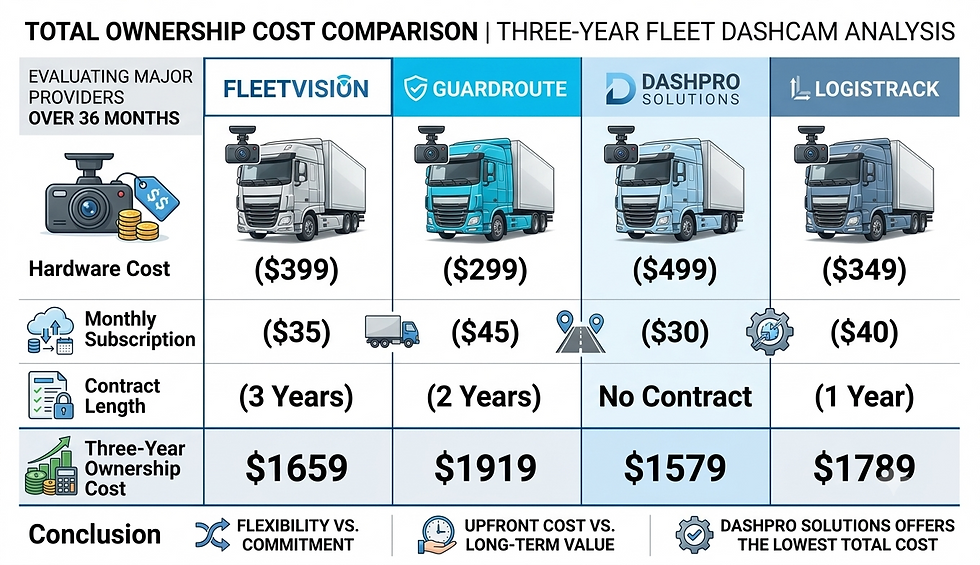
Looking at total ownership costs provides a more accurate comparison than monthly pricing alone.
The monthly subscription is only part of the equation. Small fleets should evaluate hardware, service fees, contract commitments, and replacement costs together.
Provider | Hardware Cost/Truck | Monthly Fee/Vehicle | Contract Length | 3-Year Total/Truck |
Samsara | Quote required — pricing not published | Quote required — pricing not published | Typically multi-year | Quote required |
Motive | Approximately $150–$400+ depending on package | Approximately $25–$40+ | Typically multi-year | Approximately $1,050–$1,840+ |
Lytx | Quote required — pricing not published | Quote required — pricing not published | Typically multi-year | Quote required |
Azuga SafetyCam | Approximately $170–$300 | Approximately $20–$30 | Often more SMB-friendly | Approximately $890–$1,380 |
Pricing reflects publicly discussed market ranges and industry estimates as of 2026. Actual quotes vary based on fleet size, contract length, and selected features.
For a fleet camera 10 trucks deployment, even a $10 monthly difference per vehicle becomes $3,600 over three years. That is why experienced fleet owners compare total ownership cost, not promotional pricing. The cheapest monthly subscription is not always the least expensive option.
Red Flags to Watch Before Signing Any Dashcam Contract

Automatic renewal clauses
Some agreements automatically renew for another term if notice is not provided within a narrow window. Missing that deadline can extend costs for years.
Hardware that stops working after cancellation
Certain vendors disable features when subscriptions end. Confirm what remains functional if you leave.
Bundled services you did not request
Sales teams sometimes package telematics, ELDs, and safety products together. Make sure every line item solves a real operational problem.
Unclear data retention policies
Footage retention directly affects claims and investigations. Get storage periods in writing before signing.
Early termination penalties
Some contracts require payment of most remaining subscription fees. Understand exactly what happens if you exit early.
How a Dashcam Lowers Your Insurance Premium

A fleet safety camera small business strategy can influence insurance costs in several ways.
First, dashcams accelerate claim resolution. Clear video evidence often reduces investigation time and legal expenses.
Second, footage helps exonerate drivers from false claims. The trucking industry regularly faces staged accidents and disputed liability situations. Video evidence can quickly establish what happened.
Third, safety data provides leverage during renewal discussions. Insurers increasingly look at fleet safety programs, coaching processes, and incident trends when evaluating risk.
According to research from the Federal Motor Carrier Safety Administration and industry safety studies, the average cost of a large truck crash involving injury can exceed $148,000, while crashes involving fatalities can exceed $7 million. Preventing or successfully defending against even one major claim can justify the cost of a dashcam system.
Questions to Ask Any Dashcam Vendor Before You Sign

What happens if I cancel before the contract ends?
This question immediately reveals how flexible the agreement really is. A transparent vendor should provide a written answer.
Who owns the hardware after installation?
Some providers retain ownership while others transfer it to the customer. Ownership affects long-term value and flexibility.
How long is footage stored by default?
A good answer includes specific retention periods and upgrade options. Avoid vague responses.
Can I install the cameras myself?
For small fleets, self-installation reduces deployment costs and downtime. The best systems are designed with simplicity in mind.
Can I see a complete three-year cost estimate today?
Experienced fleet owners ask for lifetime cost projections. Any vendor unwilling to provide one deserves extra scrutiny.
Small fleets face the same liability exposure as major carriers. They simply have fewer resources to absorb a costly claim. The right fleet dashcam for small fleet operation delivers protection, accountability, and evidence without enterprise pricing or unnecessary complexity. Before making a decision, review the comparison guides and vendor breakdowns across our site to find the solution that matches your fleet's size, budget, and goals.

Comments